Pixel Montage
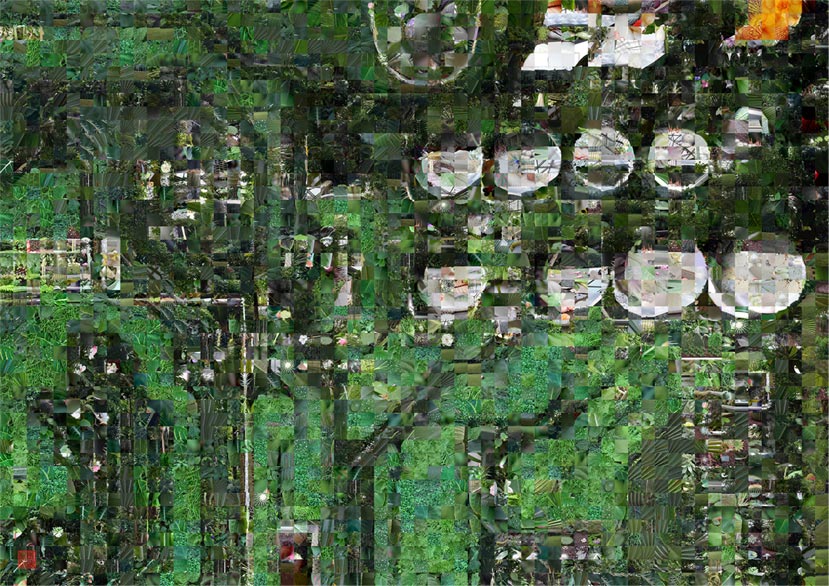
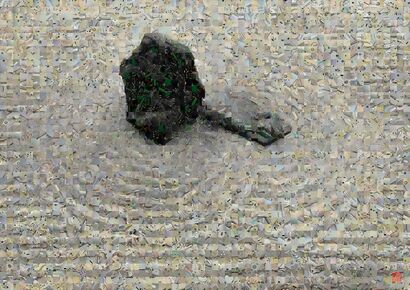
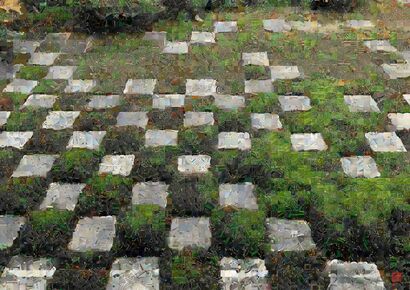
“Pixel Montage” is a technique I devised in 1988, aimed at cutting and reconstructing printed materials and photographs to create new images. This technique pursues expression by alternating between micro and macro perspectives.
The inspiration for this technique dates back to my childhood. From a young age, I loved collecting commemorative stamps, character cards, candy wrappers, river stones, leaves, pinecones, and arranging them to admire. One day, I was astonished to see the inside of a television my father was repairing. Inside the simple box covered with a cathode ray tube and plastic, there was a circuit board with small components neatly arranged. It reminded me of the townscape viewed from a mountain, and I was fascinated by the strangeness of the world inside the television, the size of myself, and the size of my home. This experience deepened my interest in arranging collected items to create new images.
As an adult, I started photographing and collecting images of various subjects, from organic ones like lips, Japanese festivals, plants, and flowers, to inorganic ones like buildings. By observing each image, taking in information about color, shape, and texture, and trimming each one into squares to piece them together, I shape the overall image. The common theme is the “now,” aiming to create works where the beauty of details captured from a micro perspective coexists with the harmony of the whole depicted from a macro perspective. I always follow natural inspiration, taking or collecting massive amounts of “now” in various places, and reconstructing them to create works.
“Pixel Montage” is an attempt to fuse micro and macro perspectives, creating new images that transcend time and space. The core of this technique lies in the process of deeply contemplating how the collection of each image shapes the overall image and refining the ideas. Through this technique, I aim to provide visual surprises and the joy of discovery, allowing viewers to find new stories in the work.
Zen City
“Botanical gardens” and “electronic circuits” might seem vastly different in appearance and structure, but I find them fundamentally similar. This sense of similarity is the foundation of my art series, “Zen City.” Using countless photos taken in botanical gardens, I express the internal electronic circuits of devices from an aerial perspective. Here, I explain why botanical gardens and electronic circuits are similar.
Botanical gardens are ecosystems where delicate life forms harmonize and influence each other to create a unified whole. Similarly, electronic circuits consist of intricate components intricately interconnected to form a cohesive system that powers an entire device. This intersection of the “micro” and “macro” perspectives is the commonality I see between them. The veining of leaves and the network of roots bear an uncanny resemblance to the wiring of electronic circuits, sparking my creative inspiration.
I enjoy strolling through botanical gardens. The beauty of each plant and the latent energy of life within them deeply move me. Simultaneously, I am fascinated by observing the intricate designs inside various electronic devices. The precision of their design and the marvels of human technology captivate me. It is at the intersection of these two hobbies that my artwork “Zen City” was born.
“Zen” is a philosophy that emphasizes inner peace and concentration to perceive the essence of things. Viewed from above, electronic circuits embody the spirit of Zen. The orderly arrangement of countless parts, creating a harmonious whole, is the essence of “Zen City.” Observing electronic circuits from an aerial perspective allows one to escape the chaos of daily life and immerse oneself in tranquility and harmony.
From a microscopic perspective, both electronic circuits and botanical ecosystems are composed of countless small elements that combine to create a larger system. From a macroscopic perspective, each looks like a vast city. This shift in perspective is central to my work.
Gazing and journeying through the completed “Zen City” is akin to life itself. By focusing on each detail, we can appreciate the overall beauty and harmony. By viewing the whole from an aerial perspective, we can rediscover what is truly important in life.
“Zen City” offers an opportunity to reevaluate the beauty and harmony hidden in our daily lives. Moving from a micro perspective to a macro one, and then back again, we can deepen our understanding of our own lives. Through this work, I hope to help you find your own “Zen City.”