
13 Feb Max Coppeta | Hall of Fame
VISIONARY / MULTIDISCIPLINARY / ANALYTICAL EXPERIMENTER
Born in Salerno (1980) Max Coppeta is a pioneer of contemporary art and the creator of the first Scannographic Work in history (“Il Regalo di Dio”, Naples, 2001). Trained in Scenography and Visual Arts, he refined his multimedia aesthetic through collaborations with masters such as Studio Azzurro and La Fura dels Baus.
Following a robust career in Visual Marketing and Design, since 2012 he has focused on his “Synthetic Rains” project: a visionary series that uses chemical compounds to simulate the mysteries of nature. His installations have been exhibited in global hubs including Tokyo, Houston, Singapore, and Venice, becoming a subject of academic study for prestigious institutions like the Filiberto Menna Foundation and the D’Ars Foundation, University of Salerno, Polytechnic University of Milan, University of Turin / Multidams, University of Naples / Cultural Heritage.

Hall of Fame – The Interview
ART PRACTICE
Your artistic career began in 2001 with an exhibition of your work in Naples. How has your art evolved since then?
Truly, authentic research goes hand in hand with life itself. The exhibition in Naples, in Piazza del Plebiscito, was probably the first showcase that allowed me to interact with a wide audience: I was just 21 years old and was presenting my first ‘scannographic’ work.
Even though I studied scenography, I have always believed in innovation.
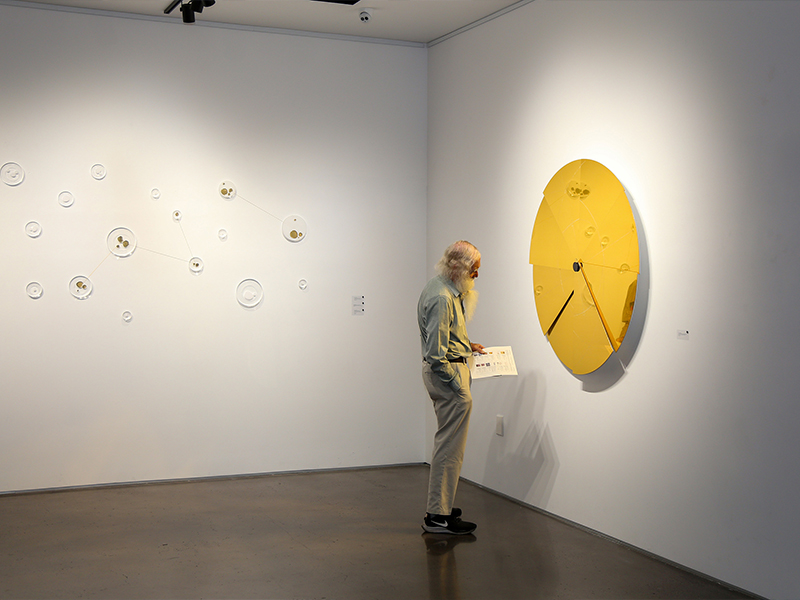
My initial approach was strongly oriented towards digital—despite starting from traditional media—with projects that have received major international recognition. However, the real turning point came when I decided to move beyond the purely immaterial dimension and engage with matter. I wanted to translate that metaphysical imagery, until then narrated digitally, into physical installations and “micro-spectacles” in the form of tangible works, capable of inhabiting real space.
Describe your work in 3 words.
DECEPTIVE / MUTABLE / METAPHYSICAL
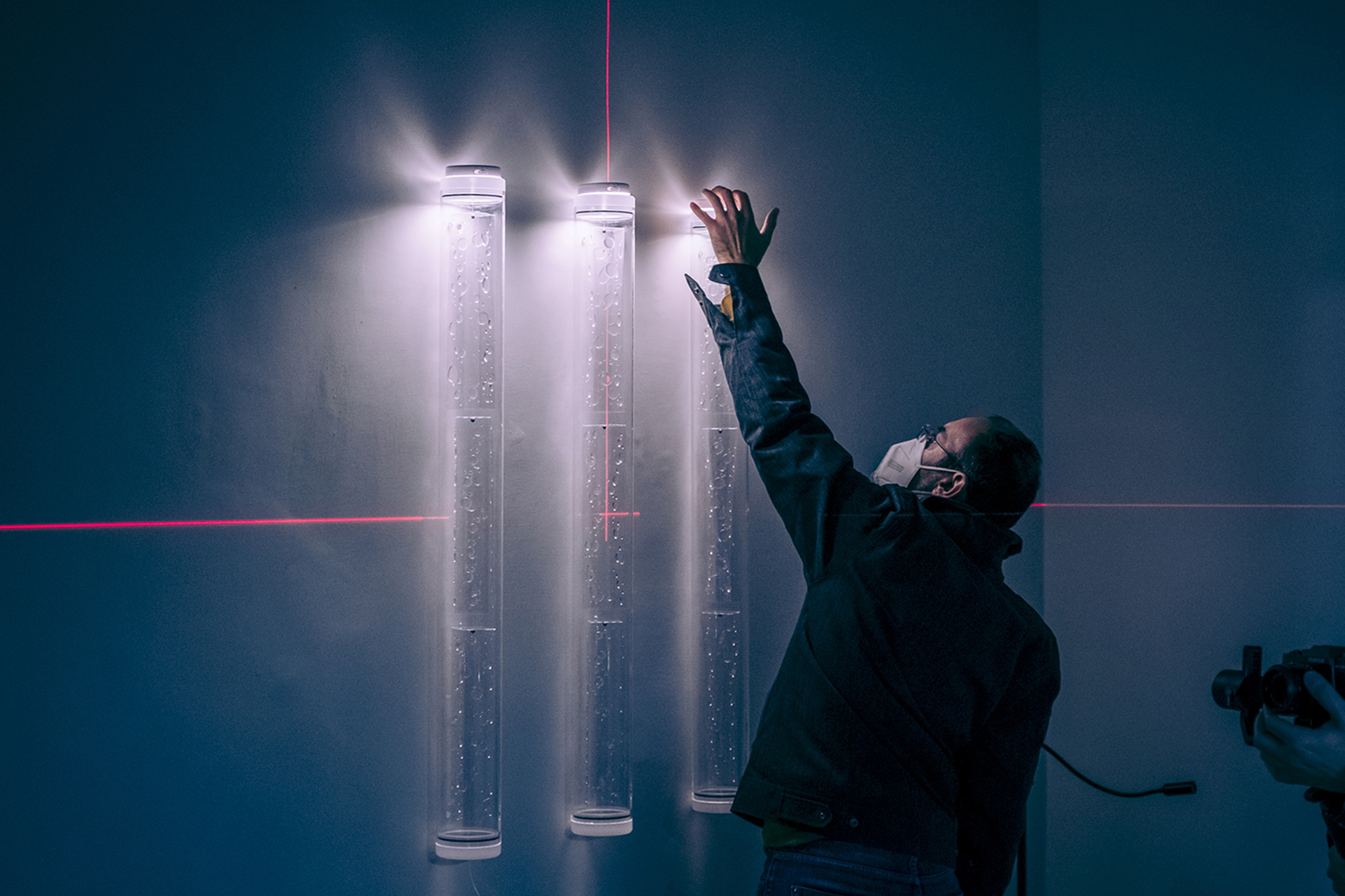
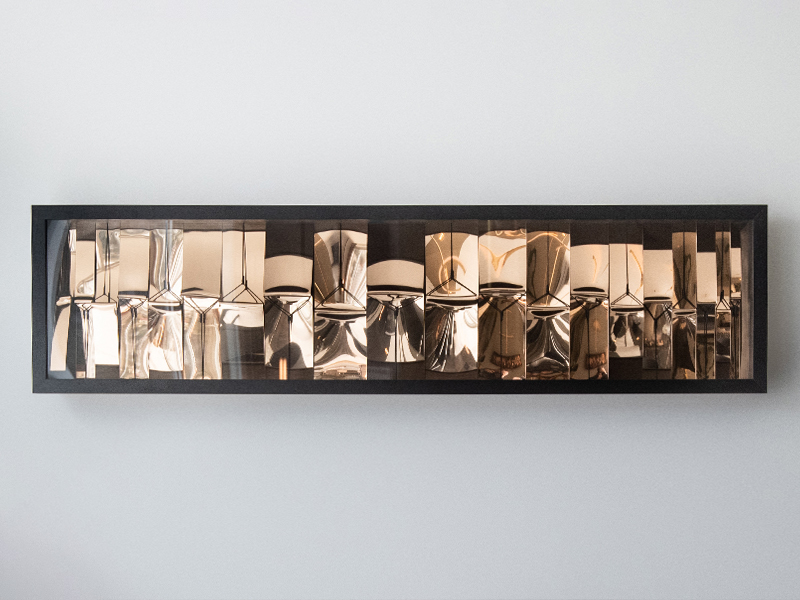
My works constantly play with the viewer’s perception. Through the use of crystallized liquids, glass, and refractions, I seek to create what I call a “credible deception.” My research challenges the eye to distinguish between natural and artificial, between fluid and solid, transforming matter into a visual paradox capable of disorienting and captivating.
For me, a work is never static, even when physically still. Through interaction with ambient light, the surrounding space, and the viewer’s movement, my creations continually change. This characteristic reflects my exploration of “becoming” and “lazy sculpture”: the work seems to expand beyond its physical boundaries to exist in an ever-changing temporal and atmospheric dimension.
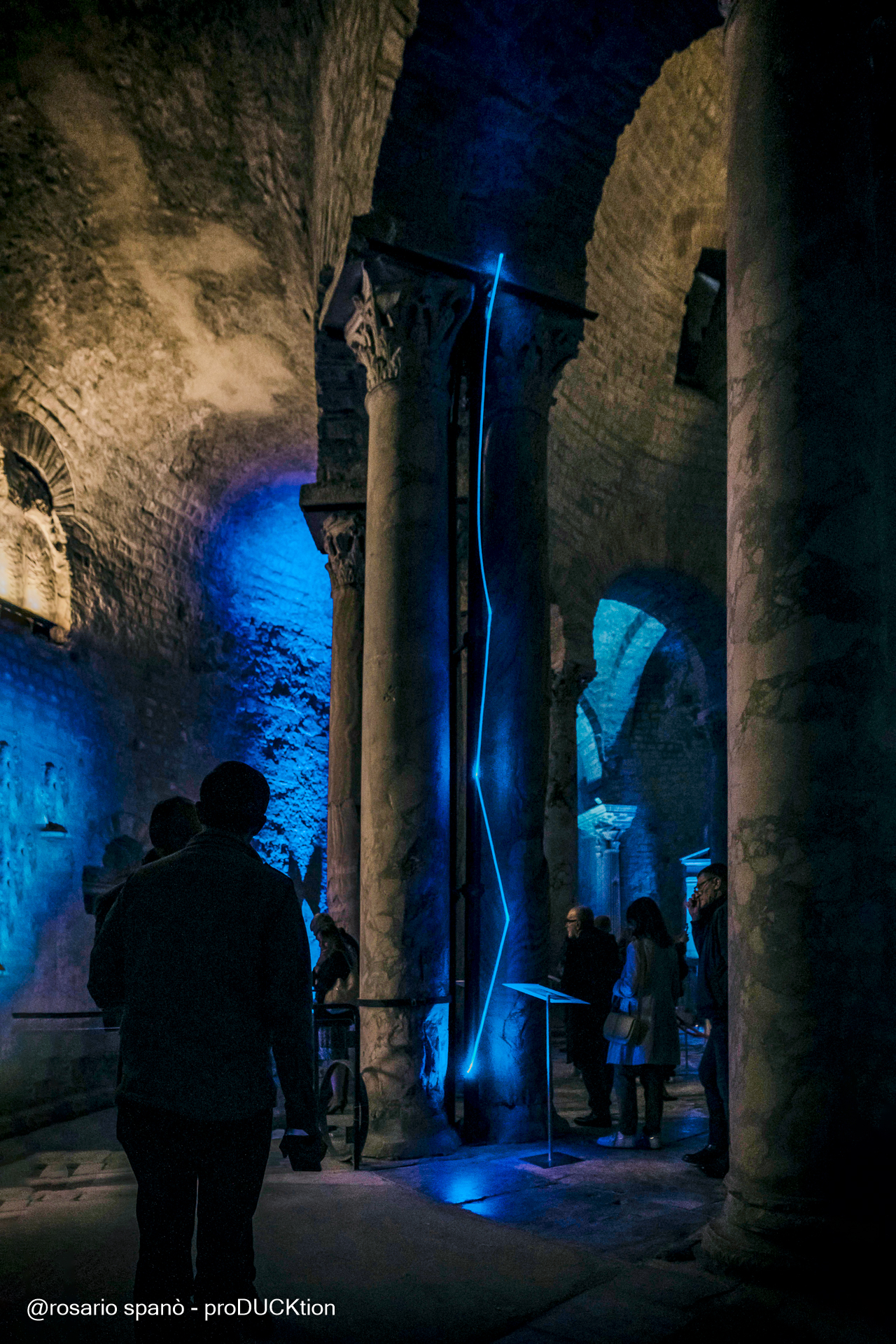
Beneath the technical rigor and the use of industrial or technological materials, I ignite a profound search for meaning. My work is not a simple aesthetic exercise, but an investigation into invisible concepts such as gravity, time, and the soul. As emerges from my notes and reflections, making art for me means “laying bare to express the sense of the absolute,” making my works bridges between tangible reality and an inner world made of symbols and silences.
What was the turning point in your life that led you to where you are now?
Defining where I am now is complex: I’ve always measured my journey not so much by the steps I’ve taken, but by the mistakes I’ve made. One thing, however, I’ve come to realize: you should never stop, never give up, and above all, never take yourself too seriously. Art, after all, isn’t a destination, but a never-ending journey. In this journey, more than any single moment, the encounters I’ve had have been crucial.
What was the craziest moment of your artistic career?
I have no doubt about this answer: the most incredible moment was having the honor of the friendship of Patrizia and Aika Sapone (daughters of Michele Sapone, Picasso’s famous tailor) and Antonio Sapone. Their stories, their affection, and their closeness have profoundly changed my life, both as a man and as an artist.
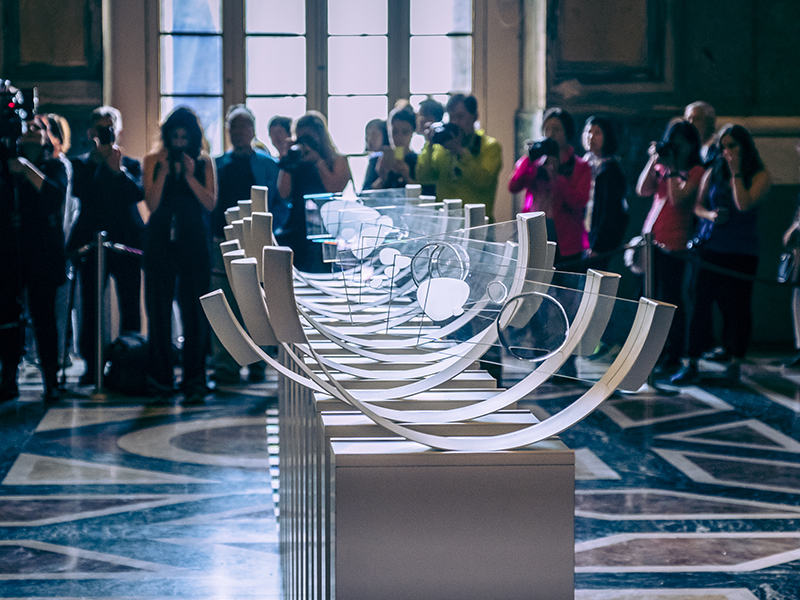
Equally significant was receiving an Arnaldo Pomodoro medal from Stefano Roveda (Studio Azzurro). Finally, thanks to Art 1307, I had the opportunity to exhibit in prestigious contexts such as the Royal Palace of Caserta, the MOHA Museum in Lancaster, and the Metropolitan Art Museum in Tokyo, during the celebrations for 150 years of diplomatic relations between Italy and Japan.
What are your current or future projects?
I don’t follow a set of priorities: a project is either important and necessary, or it doesn’t fit into my work. I’m currently busy on several fronts: from exhibitions with the Ferrero galleries in Ivrea and SyArt in Sorrento, to artistic engagement with the Baroque works of the De Chiara De Maio Foundation. I’m also designing a light installation for the Baccaro gallery and a fashion collaboration with the Anatomie brand, not to mention my now-established relationship with Art1307 in Los Angeles.
ARTE LAGUNA PRIZE EXPERIENCE
How would you describe your experience during the last edition of Arte Laguna Prize? How has this event influenced your career?
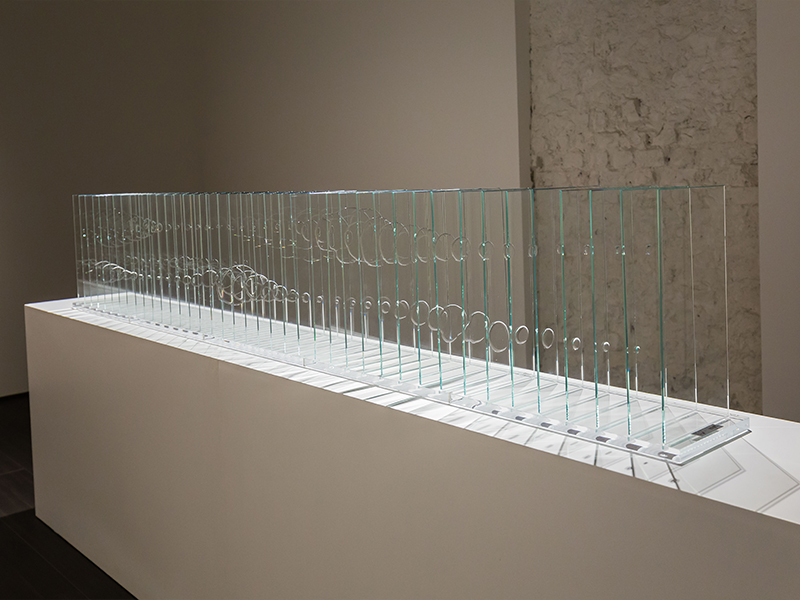
Many years have passed, but I still clearly remember that energizing experience. At that time (since 2012), I was pursuing a new research project in which transparency and water were the absolute protagonists. Water, in particular, was a simulation capable of deceiving even the most attentive eye, evoking profound suggestions and perceptions.
I used to participate in competitions aligned with a research and experimental approach, and I immediately identified Arte Laguna 2014 as the ideal context for Long Drop. I entered without any expectations, until I was informed that the work had been shortlisted. I was surprised and deeply satisfied: bringing a glass sculpture to Venice—in the realm of the world’s best workshops—was no small challenge.
Since then, my research has been the subject of significant evaluation, and I can say with absolute certainty that the award was a true springboard for my career.
Is there a secret to stay motivated daily?
I proceed with a healthy disinformation of daily life and constantly dismantling the stage that sometimes casts me as the protagonist; I persevere with the eternal dream that something beautiful may happen before my eyes, something worth paying attention to.
How do you keep yourself motivated every day?
My motivation is a contradiction: I receive visions in dreams, but I also suffer from intense sleep disorders—central apnoea, parasomnia, and other neurological symptoms. So sleep is both my inspiration and my battleground. Despite my suffering, I stay committed. My drive comes from love—love for truth, for beauty, for others. I see art as service. My goal is to give shape to the invisible—to let others experience what I’ve been shown. We spend a third of our lives asleep, yet dreams remain largely misunderstood. My work is about bridging that gap—making the unseen seen, not just for me but for anyone who needs to remember that what’s hidden isn’t gone.
Among the artist’s most notable projects are the World Summit Award for the e-Content Award Italy, participation in TVIRUS (Oliviero Toscani’s creative hub), and selection for Roma Design Più at Sapienza University of Rome. Other milestones include the Critics’ Award at the PWI at the Michetti Museum, the PIAFF (Potenza International Animation Film Festival), mentions from Adobe/Macromedia in California, participation in the Scrittura Mutante section of the Turin Book Fair (2003, 2005, and 2007 editions), and the Top Talent Award at the Europrix Multimedia Awards in Salzburg.
Curatorial contributions: Antonello Tolve, Alessandro Demma, Jacqueline Ceresoli, Cynthia Penna, Michelangelo Giovinale, Stefania Trotta.
Sorry, the comment form is closed at this time.